Table of Content

Roulette Online: Rules, Bet Types, Demo Play and Live Dealer Games

Last reviewed: 2026 editorial cycle | Reviewed by: Claire Bennett, Senior iGaming Editorial Lead | Scope: educational and informational only

[⚡ THE 30-SECOND SUMMARY]
• Roulette is a game of pure chance: a ball settles into one numbered pocket, and payouts are fixed regardless of previous results.
• European roulette (37 pockets, single zero) carries a 2.70% house edge; American roulette (38 pockets, double zero) carries 5.26%; French roulette with La Partage drops the edge on even-money bets to 1.35%.
• Inside bets pay more but hit rarely (straight up = 35:1, 2.70% chance). Outside bets pay less but hit often (red/black = 1:1, 48.65% chance).
• Covering all 37 numbers guarantees a loss of exactly one betting unit per spin. The house edge cannot be "closed" by coverage.
• No betting system (Martingale, Paroli, D'Alembert, Fibonacci) changes expected value. Progressions only reshape variance and can empty a bankroll fast.
• Real-money interactive casino games, including roulette, cannot legally be supplied to residents of Australia under the Interactive Gambling Act 2001. Demo play, land-based venues and free social simulators sit outside that prohibition.
• Support in Australia: BetStop national self-exclusion register (betstop.gov.au) and Gambling Help Online on 1800 858 858.

Roulette remains one of the most recognisable casino table games in the world. Simple basic rules on the surface, surprising statistical depth underneath, once you start comparing inside bets and outside bets. Whether it is played on a physical wheel at a licensed land-based venue or accessed as a digital roulette game through an interactive platform, the objective never changes: predict which compartment the ball will land in after a spin.

In Australia, interactive gambling services fall under the Interactive Gambling Act 2001 (IGA), which prohibits the supply of real-money online casino table games to Australian residents. According to the NSW Gambling Survey 2024, overall casino table game participation among adults sits at 4.3%, yet nearly 19.2% of active table game players experience moderate-to-high gambling risk. That gap matters. Understanding the true mechanics, the house edge and the legal boundaries of roulette online is therefore worth doing before you open a practice demo, and certainly before you assess any real-money table offer.

"Among people who play casino table games, 19.2% are classified as moderate- or high-risk gamblers, roughly three times the all-gambling average." - NSW Gambling Survey 2024, Casino Table Games Topic Summary. https://www.responsiblegambling.nsw.gov.au


Provider

Evolution

RTP

97.30%

Volatility

Low

Min bet

€0.10

Max bet

€100

Max win

€1,000,000

Roulette Online Rules, Bet Types, Demo

"A transparent casino review or guide must examine regulatory conditions, table limits and mathematical mechanics long before discussing potential wins or headline bonuses. When evaluating roulette, understanding the underlying odds and jurisdiction rules is the only reliable way to protect your bankroll." - Claire Bennett, Senior iGaming Editorial Lead

What Roulette Is and How the Game Works

Roulette is a classic casino game of chance. A ball is spun around a circular wheel divided into numbered, coloured pockets until it settles into a single winning compartment. The round is managed by a dealer roulette (or a certified digital random number generator) who oversees bet placement on the designated roulette table, announces the start and end of each wagering round, and processes all game payouts.

The game is engineered so that every individual spin is statistically independent of previous outcomes. That independence is not a marketing claim. It is a licensing condition for certified equipment.

What Roulette Is and How the

"Each wheel's behaviour must be independent of previous results and of other devices." - Australian/New Zealand Gaming Machine National Standard. https://www.legislation.nsw.gov.au

Updated: the Australian/New Zealand Gaming Machine National Standard requires licensed electronic and physical spinning wheels to maintain equal probability across all pockets and to operate independently of prior results. Past outcomes exert zero influence on future spins. No pattern, no memory, no "hot" number.

[📊 EMPIRICAL FACT: THE LAW OF LARGE NUMBERS IN ROULETTE]
The theoretical probability of any single pocket landing on a European wheel is 1/37 ≈ 2.7027%.
Large simulation datasets (public logs covering more than 1,000,000,000 recorded spins) show that once samples exceed roughly 100,000 spins, the observed frequency of every individual pocket converges on its theoretical rate within a fraction of a percentage point. Red sits near 48.65%, black near 48.65% and green near 2.70%. Short samples of 10-100 spins routinely produce extreme streaks ("dispersion noise"), but across long samples the mathematical house advantage returns to 2.70% with striking consistency.
Updated the Australian New Zealand Gaming
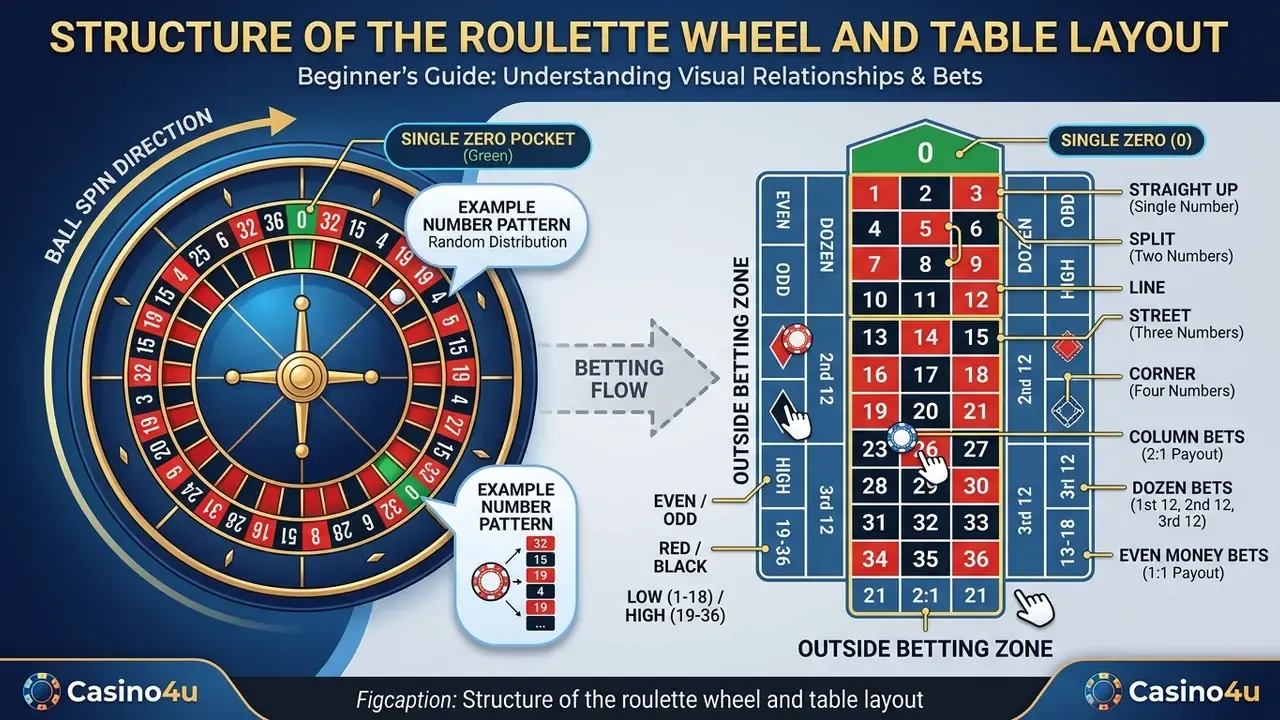
roulette wheel and table layout diagram

The Wheel, the Ball and the Roulette Table Layout

The core machinery of roulette consists of a physical or virtual roulette wheel, a small ball, and a structured roulette table layout where players place their chips. The wheel features numbered pockets alternating between red and black, with green pockets designated for zero (0) and, in certain variants, double zero (00). Numbers are not arranged sequentially around the rim. The sequence is fixed so that adjacent pockets usually alternate in colour and so that high/low and odd/even values spread evenly around the wheel.

Grid topology of the betting layout. The numbers 1 to 36 are printed on the green baize as a grid of 12 horizontal rows containing 3 numbers each, forming three vertical columns. The zero (and 00 on American layouts) sits at the head of the grid. Outside betting zones, meaning red/black, odd/even, low/high, dozens and columns, frame the central number block along its side and bottom edges. Some European and French tables also include a "racetrack", an oval track that mirrors the physical order of pockets on the wheel and is used for neighbour and section bets.

During a round of playing roulette, players select chip values and position them on specific numbers or groupings on the table layout. The dealer roulette then spins the wheel in one direction and launches the ball in the opposite direction along an outer track. As the ball loses momentum, it drops into one of the wheel compartments. The pocket where the ball comes to rest determines the winning number, colour and sector for that spin.

The Wheel, the Ball and the

A Short History: From Blaise Pascal's Perpetual Motion Machine to Modern Casinos

Roulette emerged in 18th-century France. The most widely cited origin story credits the physicist and mathematician Blaise Pascal, whose 17th-century experiments with a perpetual motion machine produced an unintentional randomness device. Alternative accounts trace the wheel's ancestry to games brought back to Europe by traders.

In the 1840s, brothers François and Louis Blanc removed the double zero (00) from the then-standard 38-pocket wheel, creating the 37-pocket single-zero layout used today. One change, halved cost. It cut the house edge from 5.26% to 2.70% and helped popularise the game in Monte Carlo. The United States retained the original two-zero format, which is why the higher-edge version is still known as american roulette.

A Short History From Blaise Pascal's

European Roulette, American Roulette and French Roulette

The three primary variations of the game, european roulette, american roulette and french roulette, differ in wheel structure, house edge and specialised table rules.
  • European roulette:Features 37 pockets containing a single zero (0) and the numbers 1 to 36. That single zero establishes a standard house edge of 2.70%.
  • American roulette:Contains 38 pockets thanks to the addition of a double zero (00) alongside the single zero. The extra pocket lifts the casino's mathematical advantage to 5.26%, which makes american roulette statistically less favourable to the player. Readers comparing formats can also review how different iGaming platforms and casino product categories present variant selection and table rules.
  • French roulette:Built on the same 37-pocket single zero layout as european roulette, but with special rule mechanics such as La Partage or En Prison. Under La Partage, if the ball lands on zero, players who placed even-money outside bets recover half their stake, which effectively reduces the house edge on those specific wagers to 1.35%. Under En Prison, the even-money stake is instead "imprisoned" for one further spin and released in full if that spin wins.
European Roulette, American Roulette and French

Roulette Rules: How a Round Runs and How to Place a Bet

Standard roulette rules follow a strict, sequential timeline. It governs how chips are placed, when bets are closed, how the spin is conducted, and how winning outcomes are settled. The player's objective is to place wagers on a single number, a combination of numbers, or a general category such as red/black or odd/even, before the dealer stops incoming bets.

Financial record-keeping and compliance standards, such as those audited across Australian gaming frameworks, require that every transaction within a game round, from the initial chip selection to final payout settlement, is fully auditable and paid at fixed multipliers. Each gaming fact must be documented at the moment it occurs or immediately after the event concludes. That is precisely why a winning number is called and marked before any chips move.

Roulette Rules How a Round Runs
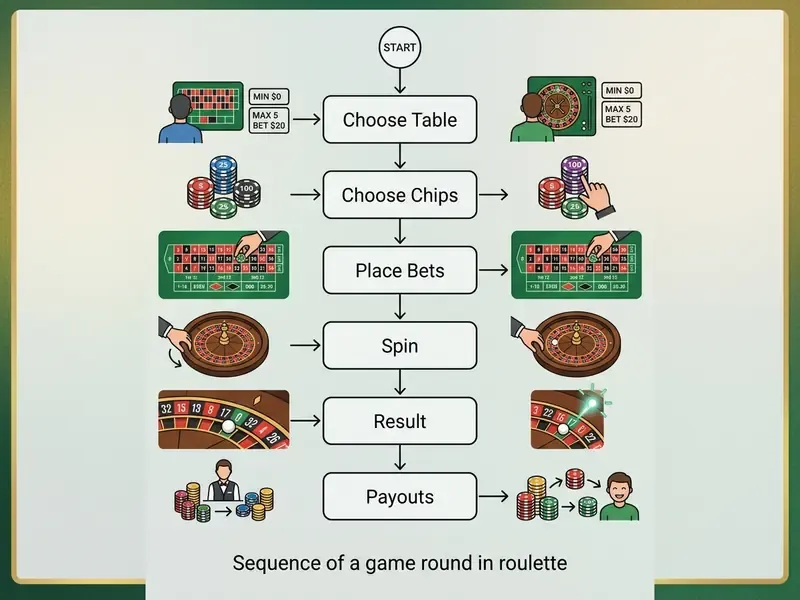
roulette game round step by step flowchart

Game Sequence: From Chip Selection to the Spin Result

A standard round of roulette progresses through six operational steps:

  1. Chip selection: The player chooses chip denominations matching their intended wager size for the round.
  2. Bet placement: Chips are positioned on the desired sectors of the roulette table before or immediately after the wheel is set in motion.
  3. Bet closure: The dealer roulette (or the automated system) announces "No more bets," closing the layout to further chip placements or adjustments.
  4. Spin and ball drop: The ball travels around the spinning roulette wheel until it drops into a final pocket.
  5. Winning call: The winning number and colour are formally announced, and a physical marker (marker or dolly) is placed on the winning grid position. Players must not touch chips while the dolly sits on the layout.
  6. Payout settlement: Losing bets roulette are collected by the house, and winning bets receive payouts according to fixed odds tables before a new round begins.
Game Sequence From Chip Selection to

How to Place a Bet on the Layout

To place bet accurately on the layout, players position their chips directly onto the designated lines, corners or boxes representing their chosen outcome.

Single-number bets require placing chips inside a single numbered square, whereas combination bets require placing chips on the intersecting lines between numbers. Larger group wagers, such as dozens or columns, are made by placing chips inside the designated boxes along the outer borders of the table grid. The data captured for every wager is consistent across formats: chip denomination, selected numbers or sector, total stake, spin identifier, winning number, payout multiplier and settled amount.

How to Place a Bet on

Types of Roulette Bets: Inside Bets and Outside Bets

Wagering options in roulette split into two main categories based on layout positioning. Inside bets cover specific numbers or small groups inside the numerical grid. Outside bets cover broader categories along the perimeter.

Inside bets offer higher payout multipliers because individual hit probabilities are low. Outside bets cover larger portions of the wheel, so they hit far more often for smaller returns.

Type of BetSpecific Bet NameNumbers CoveredPayout RatioWinning Odds (European)Winning Odds (American)
InsideStraight / Single1 number35:12.70% (1/37)2.63% (1/38)
InsideSplit2 numbers17:15.41% (2/37)5.26% (2/38)
InsideStreet3 numbers11:18.11% (3/37)7.89% (3/38)
InsideCorner4 numbers8:110.81% (4/37)10.53% (4/38)
InsideSix Line / Double Street6 numbers5:116.22% (6/37)15.79% (6/38)
OutsideRed / Black18 numbers1:148.65% (18/37)47.37% (18/38)
OutsideOdd / Even18 numbers1:148.65% (18/37)47.37% (18/38)
OutsideLow (1-18) / High (19-36)18 numbers1:148.65% (18/37)47.37% (18/38)
OutsideDozen Bet12 numbers2:132.43% (12/37)31.58% (12/38)
OutsideColumn Bet12 numbers2:132.43% (12/37)31.58% (12/38)

Inside Bets: Wagers on Numbers and Small Clusters

Inside bets focus on exact numerical picks or small adjacent clusters on the layout:
  • Straight / Single:A bet placed on a single isolated number (payout 35:1).
  • Split:A bet covering two adjacent numbers, with chips on the dividing line (payout 17:1).
  • Street:Covers a row of three consecutive numbers (payout 11:1).
  • Corner:Covers four adjacent numbers forming a square grid (payout 8:1).
  • First Four:A specialised bet covering 0, 1, 2 and 3 on European layouts (or 0, 00, 1, 2 on American wheels).
  • Six Line / Double Street:Covers six numbers across two adjacent three-number rows (payout 5:1).
Inside Bets Wagers on Numbers and

Outside Bets: Red or Black, Odd or Even, Dozens and Columns

Outside bets target broader statistical categories and tend to suit players who prefer lower volatility across a session:
  • Red or Black:A bet on whether the winning pocket will be red or black (payout 1:1).
  • Odd or Even:A bet on whether the winning number will be odd or even (payout 1:1).
  • Low or High:A bet on numbers 1-18 (Low) or 19-36 (High) (payout 1:1).
  • Dozen Bet:Covers one of three blocks of 12 numbers, 1-12, 13-24 or 25-36 (payout 2:1).
  • Column Bet:Covers one of three vertical columns containing 12 numbers (payout 2:1).
Outside Bets Red or Black, Odd

The practical advantage of outside bets is strictly the higher chance of winning an individual spin, not a lower long-run cost. Zero (and 00) is excluded from every one of these categories, and that exclusion is exactly where the house edge lives.

A Common Beginner Mistake: Can You Cover Every Number at Once?

Beginners regularly ask: "What happens if I put chips on all 37 (or 38) numbers on the layout?"

Casino rules do not forbid it. The maths, however, guarantees a loss on every single spin:

  • European example:You stake $1 on each of the 37 numbers (total stake = $37).
  • Return:One number must win. That straight-up bet pays 35:1 ($35) plus the return of the winning chip ($1) = $36.
  • Net result:$36 returned − $37 staked = −$1 per spin.
A Common Beginner Mistake Can You

Covering the entire layout does not neutralise the house edge. It converts the edge into a fixed, certain loss of $1 per $37 staked (2.70%). The same logic applies on an American wheel, where covering all 38 pockets loses $2 per $38 (5.26%). Related beginner errors include ignoring table limits, chasing losses after a bad run, and making decisions on emotion rather than against a pre-set budget.

Payouts, Odds and House Edge Across Bet Types

The relationship between payout ratios and true mathematical odds sets the fixed house edge across every roulette game variant.

In european roulette, a straight-up wager pays 35 to 1, but the actual probability of winning is 1 in 37 (2.70%). The structural gap between fair odds (36 to 1) and actual payouts (35 to 1) forms that 2.70% house edge. In american roulette, the additional double zero expands the pocket count to 38 without altering payout multipliers, which widens the house advantage to 5.26% across nearly all inside and outside bets. One point deserves emphasis: the edge is identical, 2.70% on a single-zero wheel, for every standard bet type. A straight-up and a red/black wager cost the same per dollar staked over time. Only volatility differs.

Payouts, Odds and House Edge Across

Roulette Online: Demo Modes, Free Games and Live Dealer Tables

Digital roulette software exists in two broad formats: automated games controlled by random number generators (RNG), and live dealer formats streamed from dedicated studio environments.

RNG-based roulette online delivers instant game execution, while free roulette demo modes let users practise the mechanics on a virtual balance with no monetary commitment. Live dealer roulette is different again. Operators and game studios document it as a physical-first product: outcomes come from a real wheel and ball in a studio, transmitted by video, with betting handled through a digital interface shared by multiple participants.

Roulette Online Demo Modes, Free Games

"The share of casino table game activity taking place online more than doubled, from 4.8% to 11.8%, between 2024 and 2025." - ANU, Gambling participation in Australia 2025. https://www.anu.edu.au

Roulette Demo and Free Roulette for Practice

Roulette demo and practice roulette options provide risk-free environments where players can test table mechanics, interface controls and bet layouts using virtual credits.

Integrative literature reviews on simulated gambling by Hing et al. (2025) note that free-to-play gambling mechanics share structural properties with real-money games, and they quantify the overlap between the two behaviours.

"In Victoria, 66.2% of loot box purchasers also gambled with money, indicating convergence between simulated and monetary gambling." - Hing et al. (2025), integrative review of simulated and monetary gambling convergence, Australian Institute of Family Studies. https://www.aifs.gov.au

A free roulette demo helps players understand payout calculations, volatility and game pacing without exposing capital to financial risk. It does not alter the underlying probabilities, though, and performance in a demo cannot promise the same financial outcome in real-money play. An extended winning run in a demo is dispersion noise, not skill. Worth remembering when a practice session flatters you.

Checklist: choosing a safe demo or free-play version

  1. No card details, deposit or payment method are ever required to load the practice table.
  2. Payout table and wheel type (single zero versus double zero) match the real-money version of the same game.
  3. Age-gating is present. Regulated markets often require basic age verification before granting practice access, which protects minors.
  4. The virtual balance cannot be converted, cashed out or purchased in a way that turns play into wagering.
  5. Session length and spin count are visible, so you can review results across a meaningful sample rather than 20 spins.
A free roulette demo helps players

How Live Dealer Roulette Differs From Standard Online Play

Live dealer roulette replaces automated software animation with a physical roulette wheel, a live human dealer and high-definition video streaming.
  • Physical wheel physics:Results rely entirely on ball motion and pocket capture rather than computer algorithms.
  • Multiplayer tables:Multiple remote participants place bets on a single shared table at the same time while viewing real-time layout updates.
  • Interactive chat:Players can talk to the studio host and view public table logs during active wagering windows.
  • Game pacing:Live streams run on fixed dealer-managed timers, whereas RNG software waits for the player to press spin.
How Live Dealer Roulette Differs From

Hardware and Internet Requirements

  • Connection speed:Operators of live studio products typically recommend around 12 Mbps for a stable HD stream with enough headroom to register bets before the betting window closes. Tables have been observed working on connections as slow as 4 Mbps, below which interfaces often drop the video feed and leave only the interactive betting layout.
  • Latency, not just bandwidth:A low-latency link matters more than raw speed. A laggy connection means your bets fail to register before "no more bets".
  • Interactive elements:Look for end-to-end live chat with the dealer and a synchronised display of other players' bets on the shared table.
  • Device capability:A modern phone, tablet, laptop or desktop that handles video calls smoothly will handle a live table. A webcam is not required, since the stream is one-directional.
Hardware and Internet Requirements

⚠️ HOW TO TELL A GENUINE LIVE STREAM FROM A PRE-RECORDED FAKE Some unlicensed operators imitate live play with looping recorded video clips. A genuine broadcast always shows:

  1. The dealer responding to text messages in the chat in real time.
  2. A continuous countdown timer running between spins, tied to the actual betting window.
  3. Multiple camera angles (multi-angle HD stream) with unbroken tracking of the ball's trajectory into the pocket. Additional red flags: repeated identical dealer gestures, results announced before the ball settles, a studio that looks like a dim basement rather than a controlled broadcast environment, and no published payout percentages.
HOW TO TELL A GENUINE LIVE

Roulette for Real Money: How to Assess an Offer and Choose a Format

Assessing roulette real money options means checking operator legitimacy, table betting limits, jurisdictional rules and responsible gambling controls before any deposit is made.

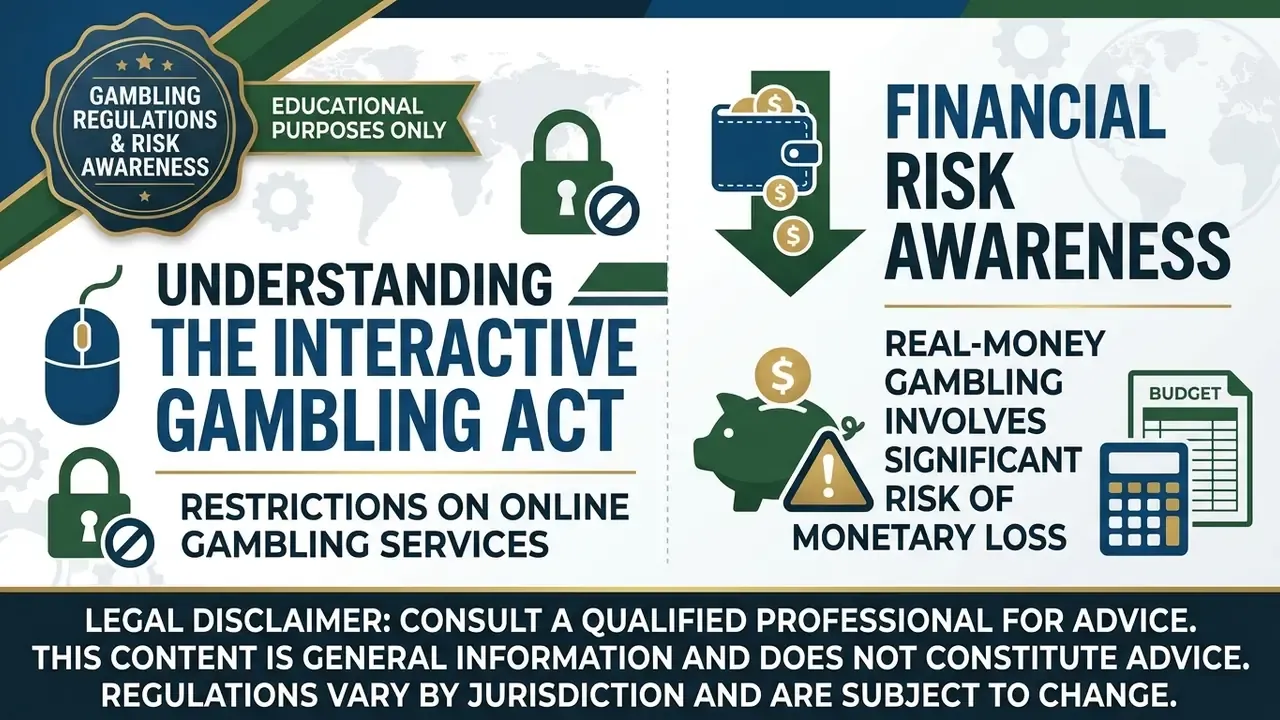
Under Australian federal law, interactive real-money roulette online is prohibited by the Interactive Gambling Act 2001. Regulators such as the Australian Communications and Media Authority (ACMA) actively enforce website blocks against offshore operators targeting Australian residents.

"Between April and June 2024, ACMA requested blocking of 50 websites, most of which offered casino games such as roulette, blackjack, poker and slots." - ACMA, Action on interactive gambling (April-June 2024). https://www.acma.gov.au

Who carries the legal risk? The IGA is aimed at providers, not individual punters. Australian residents are not prosecuted for placing a bet on an offshore casino site. The practical exposure is commercial rather than criminal: frozen or confiscated balances, unenforceable bonus terms, no local dispute resolution, no access to Australian consumer protections, and no recourse if an offshore brand simply stops paying. Since the Interactive Gambling Amendment (Credit and Other Measures) Act 2023 took effect, using credit cards, credit-linked digital wallets and certain digital currencies for online gambling in Australia is also prohibited. That restriction explains why offshore brands push players toward vouchers and crypto rails.

Who carries the legal risk The

What to Compare Before Choosing a Roulette Casino

When assessing any casino brand or table game offering, players and reviewers should audit six foundational parameters:

  1. Regulatory licensing: Verify official registration status and licensing credentials in valid operating jurisdictions, including a visible licence number and issuing authority.
  2. Game variant selection: Check for access to single-zero European or French layouts rather than higher-edge American double-zero wheels, and confirm which studios or providers supply each table.
  3. Betting limits: Inspect minimum and maximum table stake rules. For example, under the NSW Casino Control Act 1992 (Barangaroo provisions), minimum table limits for roulette are set at $25 total per spin.
  4. Payment friction and KYC terms: Review withdrawal processing times, identity verification requirements and transaction limits.
  5. RNG and studio auditing: Confirm independent testing seals (eCOGRA or iTech Labs, for instance) for digital software, or multi-camera coverage for live studios.
  6. Safer gambling tools: Check for built-in deposit limits, session timers, reality checks and self-exclusion registry access.

During our editorial review of digital casino compliance frameworks at casino4u-jackpot.com, our team assessed brand transparency parameters across multiple operator reviews. By auditing bonus terms, withdrawal limits and licensing disclosures, we settled on standards for vetting casino operators that filter out high-risk offshore brands and highlight the consumer protection controls we treat as mandatory.

What to Compare Before Choosing a

Bonus Terms and Game Weighting: Why Roulette Is a Poor Wagering Game

The single most misunderstood clause in casino promotions is game weighting, sometimes labelled bonus contribution. Pokies typically count 100% toward wagering requirements, whereas roulette usually contributes only 0-10%, and many operators exclude it from bonus play entirely.
  • Worked example:A $100 bonus with a 35× wagering requirement demands $3,500 of turnover at 100% weighting. If roulette contributes 10%, the same bonus needs $35,000 of roulette turnover to clear.
  • Low-risk bet bans:Terms frequently void wagering generated by "opposing" or near-full-coverage bets, for example covering red and black at once, or both halves of a dozen split, and can confiscate winnings for breach.
  • Max bet caps:Bonus play is normally limited to about $5 per spin. One larger stake can void the whole balance.
  • Practical conclusion:If your intention is to play roulette, a cash-only session with no bonus attached is usually cleaner than a deposit match that roulette can barely unlock.
Bonus Terms and Game Weighting Why

Betting Limits and Conditions Compared Across Formats

ParameterRNG online rouletteLive dealer onlineLand-based casino
Minimum bet$0.10 - $1.00$1.00 - $5.00$10.00 - $25.00
Maximum bet$500 - $1,000$1,000 - $10,000+Depends on VIP/high-limit room
Round speedInstant (player-controlled)30-45 seconds60-90 seconds
Fairness auditingCertified RNG testing (e.g. iTech Labs)Video capture + optical sensorsRegulator and floor inspectors
Typical audienceLow-stakes and practice playersMixed, skewed to higher rollersLocal venue and VIP play

Land-based minimums in Melbourne and Sydney commonly start at $10-$25 per spin, while digital tables can accept as little as $1. That difference matters enormously for bankroll planning and session length: at $25 a spin, a $200 budget lasts eight rounds.

Payment Methods and Withdrawal Timelines for Australian Users

The table below summarises the rails Australian users encounter and their practical trade-offs. It is provided for information only. Using them with an offshore casino does not make that service lawful under the IGA.

MethodDeposit speedTypical withdrawal timePractical notes
PayID / bank transferNear-instant1-3 business daysBank-level traceability; banks may decline gambling-coded transfers
Debit card (Visa/Mastercard)Instant2-5 business daysCredit cards are prohibited for online gambling in Australia
Neosurf / prepaid vouchersInstantNot supported for payoutsDeposit-only; withdrawals must be routed to another method
Cryptocurrency (BTC, ETH, USDT)10-60 minutes1-24 hoursNetwork fees and price volatility; no chargeback protection
e-Wallets (where available)Instant12-48 hoursOften excluded from bonus eligibility

KYC reality check. Verification is the most common cause of withdrawal delay. Regulated operators typically clear identity documents within 24-72 hours. Offshore brands, by contrast, are known to request escalating paperwork after a large win: utility bills less than three months old, selfies holding the card, source-of-funds statements, even notarised or certified copies, with each request restarting the clock. Complete verification before depositing, and treat any demand for notarised documents mid-withdrawal as a serious warning sign.

Red Flags: When to Walk Away From an Offer

  • No visible licence number, or a licence that cannot be verified on the regulator's own register.
  • No published RNG or live-studio audit certificates, and no payout percentages disclosed.
  • KYC unresolved beyond 72 hours, or new document demands appearing only after a withdrawal request.
  • Absence of deposit limits, session timers or self-exclusion tools.
  • Withdrawal caps that would take months to release your own balance.
  • Bonus terms hidden behind a login, changed retroactively, or silent on roulette weighting.
  • A "live" table that fails the pre-recorded-video checks listed earlier.

Roulette Strategy: What Betting Systems Can and Cannot Do

[⚠️ DISCLAIMER]
This information is general in nature. Progressive betting systems do not guarantee wins and can lead to substantial financial losses.

Popular roulette strategy models and progressive betting systems structure your wagering path, and that is genuinely all they do. They cannot alter the house edge or the mathematical independence of individual spins. Understanding why people persist with them matters as much as the maths: a betting system supplies a sense of control and discipline in a game that offers neither, which is exactly what makes it psychologically attractive after a losing run.

Because every spin on a certified wheel carries a negative expected value ($E[X] < 0$), no progressive wagering sequence can turn a long-term negative expectation into a positive statistical advantage. Over $n$ bets with house advantage $p$, expected loss is simply $-np$. Progressions redistribute risk between frequent small wins and rare large losses without touching that figure. Kelly-style stake sizing does not help either, because the Kelly criterion requires a positive edge that roulette players do not have.

Roulette Strategy What Betting Systems Can

"36% of people who play casino table games experience gambling harm, more than those betting on sport (35%) or playing pokies (29%)." - Victorian Gambling Harm Awareness Week 2024, VGCCC. https://www.vgccc.vic.gov.au

Martingale, Paroli, D'Alembert and the Fibonacci System

  • Martingale system:A negative progression traceable to 18th-century France, where the player doubles their bet after every loss and resets to the base unit following a win. Designed to recover all losses with a single base-unit profit, it fails badly during long losing streaks because table maximum betting limits cut the sequence short.
  • Reverse Martingale (Paroli):A positive progression where stakes double after every win for a set number of rounds, often three consecutive wins, then reset to the base unit after any loss. The aim is to capitalise on short winning runs.
  • D'Alembert strategy:A flatter progression where bets increase by one fixed unit after a loss and decrease by one unit after a win, which reduces short-term volatility compared with exponential systems.
  • Fibonacci system:A progression following the sequence (1, 1, 2, 3, 5, 8, 13...), where stakes advance to the next number after a loss and move back two steps after a winning spin. Required bankroll grows with the cumulative sum of the sequence: slower than Martingale, still steeply.
Martingale, Paroli, D'Alembert and the Fibonacci

"Among people who play casino table games at least monthly, 50.1% are classified as moderate- or high-risk gamblers." - NSW Gambling Survey 2024, Casino Table Games Topic Summary. https://www.responsiblegambling.nsw.gov.au
That frequency-risk relationship is the practical warning for system users. Progressions need many spins to express themselves, and frequent play is exactly the behaviour most strongly associated with harm.

Why Strategies Cannot Guarantee a Win

Betting systems fail to guarantee long-term wins for three mathematical reasons:

  1. Independence of spins: Past results do not influence future spins. Believing red is "due" after a run of black is the classic form of the gambler's fallacy.

    "Each wheel's behaviour must be independent of previous results; past spins do not affect future spins." - Australian/New Zealand Gaming Machine National Standard. https://www.legislation.nsw.gov.au

  2. Fixed house advantage: The presence of zero ensures the casino keeps its 2.70% (European) or 5.26% (American) edge no matter how stakes are split across wagers.

  3. Table betting limits and finite bankrolls: Progressive doubling demands exponential bankroll growth ($B = b(2^n - 1)$ after $n$ losses), which quickly reaches table caps or personal financial limits during an adverse streak. A base $10 unit needs $10,230 in reserve to survive ten consecutive losses, and most tables will cap the stake long before that.

The one genuinely useful function of a system is bookkeeping. Run a progression across a few hundred spins in a free simulator and you will see, faster than any article can explain, how a single long losing streak behaves.

Why Strategies Cannot Guarantee a Win

Responsible Gambling and Where to Get Help in Australia

Roulette is entertainment with a mathematically certain long-run cost. Not an income strategy. Practical controls that measurably reduce harm include setting a hard deposit limit before you play, using session timers and reality checks, never chasing losses, keeping gambling funds separate from household money, and avoiding play while stressed or intoxicated.

Support services in Australia:

  • BetStop, the National Self-Exclusion Register:free, confidential, and blocks licensed Australian interactive wagering providers from opening accounts or accepting bets from you for a chosen period. betstop.gov.au

  • Gambling Help Online:free 24/7 counselling and web chat on 1800 858 858.
  • State regulators:the NSW Office of Responsible Gambling and the Victorian Gambling and Casino Control Commission (VGCCC) publish self-assessment tools, family support resources and venue exclusion schemes.
  • Under 18:all gambling products are restricted to adults who meet the legal gambling age in their jurisdiction; underage gambling is prohibited.
Responsible Gambling and Where to Get

[⚠️ GENERAL WARNING] Gambling can result in the loss of money. Winnings are never guaranteed, and no game outcome can be predicted. Participation is restricted to adults who meet the legal gambling age in their jurisdiction. If gambling is causing you or someone you know harm, contact Gambling Help Online on 1800 858 858.

FAQ: Roulette Online and Live Roulette

Do I Need an Account to Try a Roulette Demo?

Access requirements for roulette demo modes depend on the platform and on local jurisdictional rules. In many international jurisdictions, free roulette demo modes open directly in a web browser with no account and no deposit. In strictly regulated regions, operators may require basic age verification before granting access to practice modes, specifically to protect minors. Social simulators that run on virtual coins with no cash value usually require a free sign-up, but never a deposit.

Can I Play Live Roulette on a Mobile Device?

Most contemporary live roulette tables are delivered through mobile-responsive browsers or operator apps, and studio suppliers design interfaces with touch input in mind. Interactive controls are expected to meet accessibility targets such as the W3C WCAG 2.2 minimum touch-target size of 24 × 24 CSS pixels, and layouts must reflow on narrow screens without losing functionality. Mobile availability still varies by operator and by table, so verify it before depositing. Stable gameplay needs a fast, low-latency internet connection, practically around 12 Mbps for HD streaming, with degradation likely below 4 Mbps, to keep real-time video running and register chip placements before the dealer closes betting.

Can I Play Live Roulette on

Are There Multiplayer Tables and Roulette Tournaments?

Yes. Multiplayer tables let several participants join a single shared live stream table, place individual wagers on the same wheel spin and interact through live text chat. All seated players usually settle against the same winning number. Roulette tournaments are competitive formats where players receive equal starting tournament chips and compete across set session times or spin counts for the highest leader board total. Free-to-play platforms often run on-demand tournaments that begin as soon as the lobby fills, plus daily freerolls.

Is Online Roulette Rigged?

In a licensed environment, no, and it does not need to be. The casino's advantage is built into the payout structure, not the spin: a number that lands once in 37 spins pays 35:1 where 36:1 would be mathematically fair. That single-pocket gap is the entire edge. RNG titles are tested against statistical batteries such as NIST SP 800-22, and live studios log every result through video and sensors. The genuine risk sits with unlicensed operators, where neither testing nor auditability can be verified.

Is a Player Breaking the Law by Using an Offshore Roulette Site From Australia?

The Interactive Gambling Act 2001 penalises the supply of prohibited interactive gambling services to Australians, not the individual placing a bet. Players face no criminal penalty, but they also receive no protection: no local complaints pathway, no guarantee of payment, and a rising chance that ACMA blocks the site mid-session.

Which Roulette Variant Should a Beginner Choose?

Single-zero European or French roulette, without exception. French tables offering La Partage halve the cost of even-money bets, 1.35% instead of 2.70%. Starting with outside bets such as red/black or dozens gives the highest hit frequency and the gentlest introduction to the rhythm of a round.

Medical, legal and financial disclaimer: this article is general information for educational purposes and is not legal, financial or clinical advice. Gambling laws differ by state and country; verify the rules that apply where you are located. If gambling is affecting your wellbeing, contact Gambling Help Online on 1800 858 858 or register with BetStop at betstop.gov.au.