Table of Content

Mines: How to Play the Casino Game Online, in Demo and for Real Money

Last updated: January 2026. Reviewed by the editorial team at casino4u-jackpot.com. Mechanics, RTP and table limits can change on the provider's side, so always check the game rules inside the operator's interface before you stake anything.

Mines is one of the most widely played instant titles in online casino lobbies. A grid of closed tiles, a rising multiplier, and one button that decides how the round ends. Simple to open, harder to play well.

This guide covers what you should understand before your first stake: how the grid and the number of mines work, how multipliers and RTP are calculated, why the casino game differs from classic Minesweeper, how Auto Bet and demo mode behave, which strategies only shift variance rather than the house edge, and what an Australian player should verify before switching to real money.
Mines How to Play the Casino

Key facts about Mines at a glance

ParameterValue
Game typeInstant / grid game (casino version of Minesweeper)
ProvidersSpribe (2021, benchmark 5×5 format), Hacksaw Gaming (2022, adjustable 3×3 to 9×9 grid), plus BGaming, Turbo Games and operator "originals"
Grid25 tiles (5×5) at Spribe; from 9 tiles (3×3) up to 81 tiles (9×9) at Hacksaw
Number of mines1 to 24 (Spribe), up to 80 (Hacksaw, depending on grid size)
RTPRoughly 96.03% to 98.00% at Spribe (average near 97%); some Hacksaw builds and operator versions sit at 94% to 96%
House edgeAbout 3% on the standard Spribe configuration, and it does not change with cash out timing
Maximum multiplierUp to 1,000× (stated ceiling of the Spribe version)
Winning mechanicOpen safe tiles, then press Cash Out before you hit a mine
Core risk ruleStake 1% to 2% of bankroll, with a target multiplier set in advance
Do "predictors" work?No. Mine positions are generated fresh every round (RNG / Provably Fair, SHA-256)
Age and jurisdiction18+, licensed jurisdictions only; in Australia the IGA 2001 and the NCPF apply

«A useful casino review or game explainer puts terms, verification, and risk management ahead of promotional headlines. Mines is an engaging grid game, but understanding the underlying house edge, randomisation, and cash-out boundaries is essential before placing any stake.» Claire Bennett, Senior iGaming Content Editor.

Who this guide suits, and who should skip Mines

Mines fits a reader who wants a fast round, a visible risk dial and a clear exit point. You control two things only: how many mines sit on the grid, and when you stop. That is honest, and it is also the whole appeal.

Skip it if any of the following describes you. You are looking for a game where skill improves the outcome; Mines is not it, because there are no numeric hints to reason from. You dislike quick round cycles, since one Mines round can end in under three seconds. You are chasing losses from an earlier session. Or you want a game that clears bonus wagering efficiently, because instant and grid titles are frequently weighted at 5% to 10%, and sometimes excluded outright.

One more group: players who assume a demo streak carries over to real money. It does not. The maths is identical, the emotions are not.

Who this guide suits, and who

What Mines game is and how the casino game works

Mines is an instant, grid-based casino game online where players open hidden tiles to reveal multipliers while trying to avoid buried mines. The game borrows its look from classic Minesweeper, but it runs on a fixed house edge structure. Each successful pick raises the cash-out multiplier, and hitting a mine forfeits the round stake immediately.

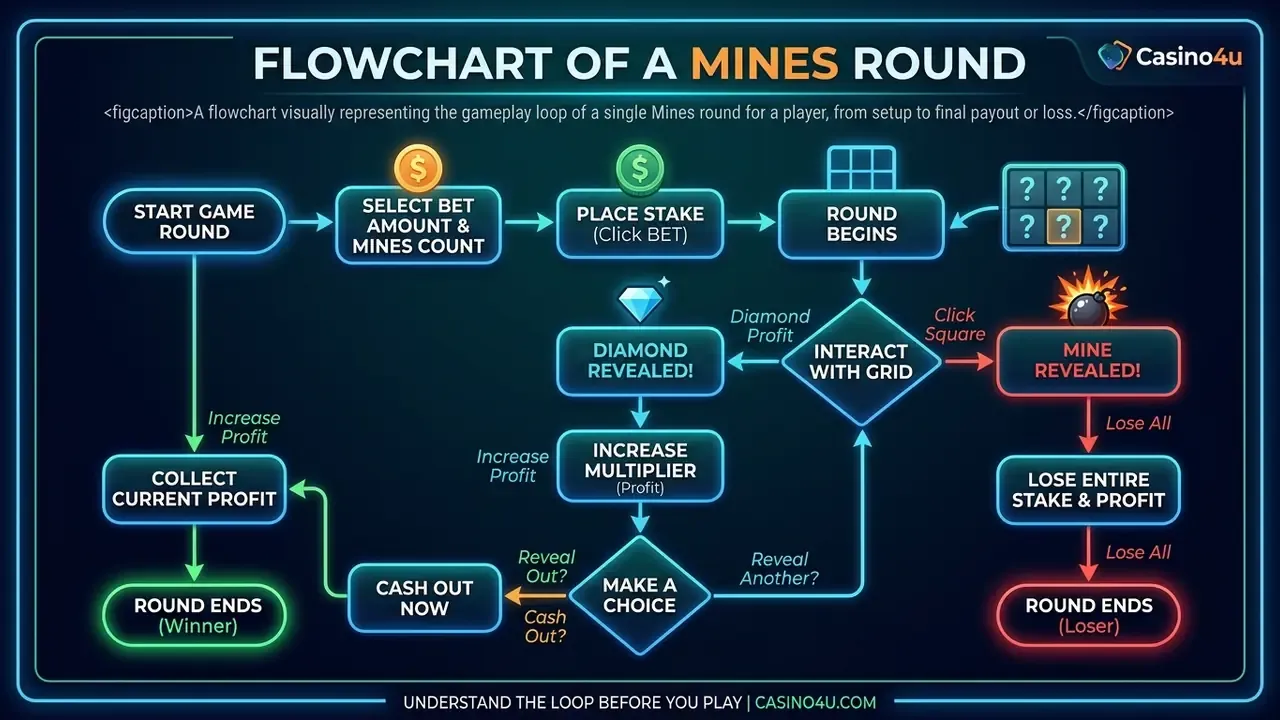
Round sequence: choose stake and number of mines → open tiles → multiplier recalculates → choose between cash out and continuing

Grid, hidden tiles and the number of mines

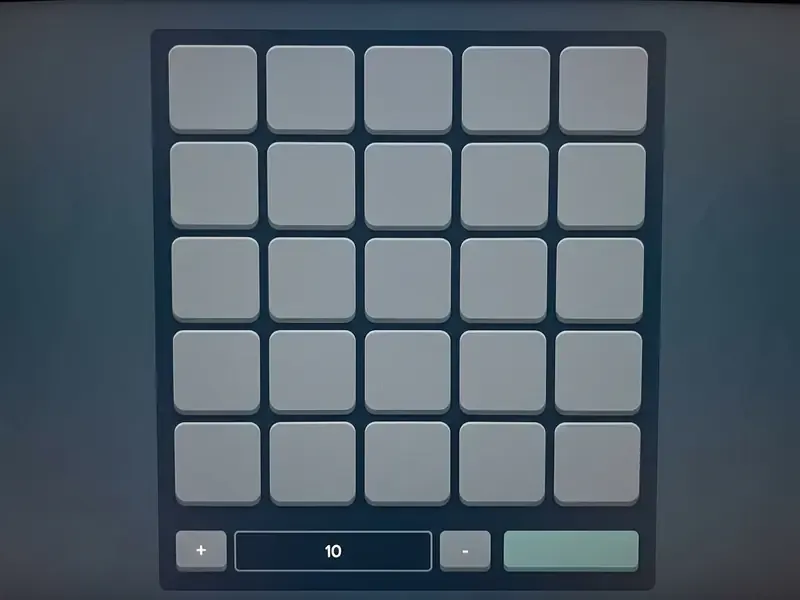
The standard Mines game grid consists of 25 hidden tiles in a 5×5 layout, concealing a player-selected number of mines ranging from 1 to 24. Before the round starts, you decide how many mines will be randomly placed across the grid. That single choice sets the difficulty and the mathematical odds of every safe pick that follows.

In popular implementations such as Spribe's Mines (released in 2021), selecting fewer mines leaves more safe tiles available, for example 24 safe tiles when the setting is a single mine. Push the setting higher and safe tiles vanish quickly, so the chance of hitting a mine on the very first click climbs sharply.

Grid, hidden tiles and the number

Grid variants and providers: Spribe vs Hacksaw Gaming

The 5×5 board with 25 tiles became the de facto industry standard thanks to Spribe, yet alternative formats exist. Your provider choice affects both the maths and the advertised RTP:

  • Classic format (Spribe, 2021): a 5×5 grid, a fixed 1 to 24 mine range, RTP between 96.03% and 98.00%, and a maximum multiplier up to 1,000×. Every table below is based on this version.
  • Customisable format (Hacksaw Gaming, 2022): the board scales from 3×3 (9 tiles) to 9×9 (81 tiles), with mines set anywhere from 1 to 80. Payouts depend on three variables at once: grid size, active mine count, and how many consecutive safe picks you make. On small 3×3 boards the multiplier climbs much faster, though the board is proportionally more crowded with danger. Worth flagging: several Hacksaw builds and operator adaptations run at 94% to 96% RTP, which puts the house edge as high as 6%, double the Spribe figure.
  • Other builds: BGaming, Turbo Games and in-house "originals" from large operators (Stake Originals and similar) reuse the same 5×5 logic with 1 to 24 mines. They differ in bet limits, multiplier steps, Provably Fair verification and how generous the demo mode is.

Practical takeaway: before you compare coefficient tables from two different reviews, open the in-game info window (the "i" button or Game Rules) and note two numbers, RTP and maximum multiplier. A shared name does not mean shared maths.

Grid variants and providers Spribe vs

Safe picks, multiplier and cash out

A safe pick happens when the tile you open holds a gem instead of a mine, which instantly recalculates and raises the current payout multiplier. Then comes the decision point, and it repeats after every reveal: press cash out and lock the win, or risk the accumulated multiplier on one more tile.

Because multipliers are derived from hypergeometric probabilities without replacement, the return to player (RTP) lands at roughly 96.03% to 98.00%, averaging near 97% across standard Spribe configurations. The multiplier schedule is calibrated slightly below true survival odds. That gap produces a structural house edge of about 3%, whenever you choose to cash out.

The probability of surviving k consecutive safe picks on a board of N tiles holding m mines is the product:

P(k) = ∏ (N − m − i) / (N − i), where i runs from 0 to k−1.

That formula explains the creeping danger. Mines stay where they are, the pool of available tiles shrinks, so each further reveal is statistically riskier than the one before it.

Safe picks, multiplier and cash out

How the casino version differs from classic Minesweeper

Here sits the expectation gap that costs beginners money. Classic Minesweeper is a logic puzzle: numbers in opened cells tell you how many mines sit adjacent, and the board can be solved by deduction. The casino version of Mines gives no numeric hints at all. Safe tiles hold gems only, and gems just push the multiplier up.

CriterionClassic MinesweeperMines (casino game)
HintsNumbers showing adjacent minesNone whatsoever
Skill typeLogic and deductionRisk control and cash out timing
Round goalClear the entire boardBank the win before hitting a mine
Influence on outcomeHigh, it is a solvable puzzleNone, RNG / Provably Fair
Stake and payoutNoneStake × accumulated multiplier

So the rule is blunt: you cannot deduce a safe tile in Mines. The only decision you genuinely control is when to stop.

How to start playing Mines online

Starting a round of Mines online means selecting a stake, setting how many hidden mines go on the grid, then confirming the bet before you reveal anything. Every step happens inside the operator's web or mobile interface, which keeps the round start and the exit fully in your hands.

Main controls: stake input, mine count selector, 5×5 grid, multiplier counter and the Cash Out button

Set bet and choose the number of mines

Before launching a round, adjust the bet size with the stake controls and select how many mines hide behind the 25 tiles. A smaller bet lets you test the pace without risking real capital, while a higher mine count lifts both volatility and the speed at which the payout multiplier grows.

Australian online gambling research keeps returning to the same point: pre-commitment tools work better than in-play willpower.

«Around one third of deposit limit users reported reduced betting time and a stronger sense of control over their play.» Australian Online Wagering Study, Gambling Treatment and Research Clinic, University of Sydney (2024). https://www.sydney.edu.au/medicine-health/our-research/research-centres/gambling-treatment-and-research-clinic.html

Scale matters too. Access to fast instant casino games such as Mines grows in step with overall online participation.

«36% of Australian adults gambled online in 2024, up from 32% in 2023.» Australian Communications and Media Authority (ACMA), How we use the internet (2024). https://www.acma.gov.au

Reveal safe tiles and continuing the round

Once the round begins, you tap or click any closed tile to see what sits underneath. A safe tile flips into a gem, the potential cash-out value updates, and the round stays live.

Choose to continue and you must pick another unopened tile from what remains. The loop repeats until one of two things happens: you cash out, or you hit a hidden mine, which ends the round instantly and wipes the accumulated multiplier to zero.

Setting up Auto Bet and autoplay parameters

To run a series of rounds without clicking tiles by hand, use Auto Bet. It is available in the Spribe and Hacksaw versions and in most operator "originals". The function locks in a chosen pattern and removes impulsive mid-session decisions:

  1. Tile template. You mark a fixed set of tiles on the grid, say three specific positions, and the system opens those every round.
  2. Round count. Set the number of automatic rounds, from a handful up to an "endless" mode that runs until a stop condition triggers.
  3. Auto Cash Out. Enter a target multiplier, for example 1.50×, at which the win is banked automatically without your input.
  4. Stop on Win / Stop on Loss. The series halts when the balance moves up or down by a set amount, or when a single loss exceeds your threshold.
  5. Behaviour after a loss. Some builds offer "increase stake by X%" or "return to base stake", which is effectively a built-in Martingale. Treat it with caution, see the breakdown below.

Important: Auto Bet does not improve RTP and it does not touch the house edge. Its only real benefit is discipline, because a pre-set Auto Cash Out and Stop Loss execute without emotion. The flip side is speed. Automatic series burn through rounds faster than manual play, so turnover and potential losses per hour rise. Practical suggestion: switch on Auto Bet only with an active Stop Loss attached.

Setting up Auto Bet and autoplay

When to cash out

Cash out when the payout multiplier reaches a target you defined earlier, or when the cumulative risk of hitting a mine outweighs the marginal gain from one more tile. Setting a strict exit condition before the round starts is what stops emotion-led decisions after a run of good picks.

In editorial observation of operator comparison methods at casino4u-jackpot.com, we notice a pattern that should not be dressed up as a scientific finding: sessions with a hard target multiplier end in a more predictable place than sessions where the player chases a big coefficient on impulse. That is an editorial note, not a controlled study. The independent evidence base supports pre-set limits specifically.

When to cash out. Cash out

«Players who set betting limits in advance spend less time gambling and feel greater control over spending.» Australian Online Wagering Study, Gambling Treatment and Research Clinic, University of Sydney (2024). https://www.sydney.edu.au/medicine-health/our-research/research-centres/gambling-treatment-and-research-clinic.html

A sensible starting frame for a beginner: target 1.5× to 2.0× on 3 to 5 mines, exit after two or three successful picks. It gives you no edge over the casino. It does keep variance inside limits you can actually see.

How the number of mines affects risk, multiplier and potential wins

The number of mines you choose scales three things at once: mathematical risk, multiplier progression speed, and the maximum potential win per round. More hidden mines means fewer safe tiles on the 5×5 grid, which lowers the chance of a safe pick while lifting the payout multiplier for each successful reveal, steeply.

Fewer mines: more cautious gameplay

Choosing between 1 and 3 mines gives you low-volatility, cautious gameplay with 22 to 24 safe tiles in play. On the first click with a single mine set, the chance of a safe tile is 96% (24 of 25), which returns a modest multiplier of roughly 1.03× the stake.

This approach softens per-pick drawdown, which suits players who value longer sessions and slow, incremental multiplier build-up. Even so, the house edge never switches off. Losing a full stake to an early mine still takes several small wins to claw back.

More mines: high risk and faster multiplier growth

Set 10, 15 or up to 24 mines and the session becomes a high-risk, high-volatility structure where a first-click loss becomes likely rather than unlucky. With 10 mines only 15 safe tiles remain, a 60% survival chance on pick one, worth about 1.65× on the first tile. With 24 mines a single safe tile exists on the whole board, a 4% survival chance, paying around 24× instantly.

Number of minesSafe tiles (out of 25)First pick survival probabilityApproximate 1st pick multiplierRisk level and pacingCash out suitability
1 mine2496.0%~1.03×Very low risk; slow growthIdeal for early, low-target exits
3 mines2288.0%~1.12×Low risk; steady growthBalanced for 1 to 3 consecutive picks
5 mines2080.0%~1.24×Moderate risk; moderate paceSuits single or double picks
10 mines1560.0%~1.65×High risk; fast scalingNeeds rapid cash out targets
24 mines14.0%~24.0×Extreme risk; high volatilitySingle-tile jackpot style

Note the limit of those figures: they describe the first click only. With 5 mines, the chance of surviving three picks in a row is 20/25 × 19/24 × 18/23 ≈ 49.6%, so slightly worse than a coin toss. On a Hacksaw 3×3 board the maths bites harder still. One mine among nine tiles gives 88.9% survival on click one, but only about 62% across three consecutive picks.

«The share of Australians gambling at risky levels rose from 11.6% to 13.6% between 2019 and 2024.» ANU National Gambling Trends Data 2019–2024, Australian National University (2024). https://www.anu.edu.au

Legal and financial risk disclaimer: Playing Mines for real money involves financial risk and the potential loss of deposited funds. Outcomes are determined by random number generation and are never guaranteed. Real-money gambling is strictly limited to legal adults (18+) in authorised jurisdictions. In Australia, licensed wagering operators must follow the National Consumer Protection Framework (NCPF). Gambling should never be treated as a financial solution or a source of income.

Disclaimer: this material is general in nature and does not replace professional advice. Real-money play carries financial risk. If gambling is causing harm, contact the National Gambling Helpline: 1800 858 858 (Australia, 24/7, free).

Mines strategy: managing stakes and avoiding needless risk

Disclaimer: the information below is general and does not replace advice from a responsible gambling professional. None of the systems described gives a mathematical edge over the casino.

A valid Mines strategy deals only with bankroll management, loss limiting and discipline, because no staking pattern alters the underlying house edge. Effective risk control means fixing bet size relative to bankroll, setting a hard session stop-loss, and accepting that tile outcomes are independent and random.

Start with small bets and fix your risk

Begin with fixed bets equal to 1% to 2% of the session bankroll, which absorbs normal short-term variance without drama. Setting session limits before you open the game is what prevents loss chasing during an ugly run.

The scale of gambling participation in Australia shows why boundaries beat any "system":

«65.1% of Australian adults took part in at least one form of gambling in the 12 months to October 2024.» National Gambling Prevalence Study (NGPS) pilot, Australian Gambling Research Centre (2024), n=3,881. https://www.agrc.org.au

As online availability widens, with ACMA reporting 36% online participation in 2024, setting strict bankroll boundaries before a session remains the single most effective personal safeguard. Not glamorous. Still true.

Decide cash out and pick count in advance

Predetermined cash-out targets remove in-the-moment decision fatigue by fixing the exact multiplier or tile count where you exit. Deciding to leave after precisely two safe picks on a 3-mine board, for instance, gives you a structured payout model instead of an emotional one.

Research published in the NSW Gambling Survey 2024 by Central Queensland University found that online gambling participation in NSW rose from 8.0% in 2019 to 26.6% in 2024. The authors stress that fast-paced online formats benefit most from rigid pre-commitment rules covering session length and cash-out points.

«Online gambling in NSW grew from 8% in 2019 to 26.6% in 2024.» NSW Gambling Survey 2024, Central Queensland University / NSW Responsible Gambling Fund (2024). https://www.responsiblegambling.nsw.gov.au

Several named approaches circulate in player communities. Here is what each one actually does to your session.

  1. Mines Martingale (doubling after a loss). The scheme: double the stake after every mine hit, then cash out at a low multiplier (1.20× to 1.50×) to recover the previous loss. The mathematical risk: at a 1.5× target, covering a losing run needs more than a doubling progression, not exactly double. Combine table maximums with exponential stake growth and one extended losing streak wipes the bankroll. With 5 mines and two picks, the round loss probability sits near 37%, so runs of six to eight losses in a row show up regularly. RTP does not budge.
  2. Pattern picking (fixed geometric shapes). Opening tiles in the same shape every time: a cross, a diagonal, the four corners. The fact: the RNG has no memory, and mine placement is generated before your first click. A pattern gives exactly the same survival probability as random clicking. The only genuine benefit is speed and consistency, which does cut impulsive picking.
  3. Low-risk cash out ("safe and sound"). Few mines (1 to 3), exit after the first or second safe pick. What it delivers: minimal variance and a longer session. What it cannot deliver: positive expectation, since the house edge is simply spent more slowly.
  4. Mine Master (maximum picks). The player opens as many tiles as possible until a subjective "feeling" of danger. Reality: survival probability falls along a hypergeometric curve, not along intuition, so this is the fastest route to a zero balance at high mine counts.
  5. Bet-level mixing ("spice up your bets"). Shifting stake levels between rounds. Reality: it changes the size of balance swings only, never the probability of an outcome. The safer version is a flat 1% to 2% bankroll stake.
  6. Keep it fun. The only "strategy" with proven value: controlling time and spend through deposit limits, time-outs and breaks. Australian research backs pre-commitment tools, not staking progressions.
Popular strategies reviewed why Martingale and

Why you should avoid hunting for winning patterns

Searching for "winning patterns" or spatial board tricks is mathematically pointless, because mine placements are generated independently each round using cryptographically secure algorithms. Earlier tile locations and neat geometric sequences carry zero predictive value for the next pick.

[💬 E-E-A-T FACT CHECK: Provably Fair and RNG verification]
"Under National Institute of Standards and Technology (NIST SP 800-90A) guidelines, certified random number generators must maintain total entropy and unpredictability. In games using Provably Fair cryptographic structures (such as SHA-256 seed pairs), server and client seeds are hashed prior to the round. This guarantees that mine positions cannot be altered dynamically or predicted through pattern tracking."
Why you should avoid hunting for

«Verifiable random functions (VRFs) ensure that game outcomes cannot be predicted or altered after a round begins.» Feng, Wu et al., «Building Random, Fair and Verifiable Games on Blockchain», arXiv preprint (2023). https://arxiv.org/

One clarification, since this myth is everywhere: Provably Fair does not require a blockchain. The mechanism rests on cryptographic hash functions, usually SHA-256. The hash of the server seed is published before the round, the player contributes a client seed, and once the round ends the server seed is revealed so anyone can recompute the mine layout. A distributed ledger is optional here rather than mandatory, which makes claims like "Mines is fair because it runs on blockchain" technically wrong.

Mines demo, free play and real money play

Mines demo (free play) lets you experience the full mechanics with virtual credits, while real money play stakes deposited funds with genuine financial risk and withdrawable payouts. Comparing both modes helps you judge pace and interface controls before committing capital.

[❓ QUIZ: Which Mines mode suits you?
1. Want to test the interface and learn the rules without risk? → Play Mines demo.
2. Want to check licensing and payment methods, then play for money? → Work through the real money checklist.]
Purpose: Routes the reader according to their current goal.
CriterionMines demo / free playMines real money
BalanceVirtual creditsReal deposit
Withdrawing winsNot possiblePossible after KYC
Mechanics and RTPIdentical to the real versionIdentical to demo
RegistrationUsually not requiredMandatory (18+, verification)
Auto BetOften availableAvailable
Main riskA false sense of controlFinancial loss

What Mines demo gives you before a first stake

Mines demo mode is a risk-free space to test different mine settings, watch multiplier growth rates, and rehearse cash-out timing. Playing with simulated currency lets you see how fast a 10-mine setup ends a round compared with a 2-mine setup, and it costs nothing to learn that.

Demo also helps when comparing providers. Interfaces, bet limits and setting depth differ across Spribe, Hacksaw, BGaming and Turbo Games, and those gaps are far easier to spot on virtual credits than on a live balance.

There is a caveat, though. Research on simulated online gambling from the Australian National University (Young Adults Gambling Online in the ACT) notes that free-to-play environments can inflate a player's sense of control. Virtual demo wins carry no financial value and do not forecast real-money results.

What Mines demo gives you before

«Young people tend to move from gambling-style games into real-money online betting.» Young Adults Gambling Online in the ACT, Australian National University / ACT Gambling and Racing Commission (2023–2024). https://www.anu.edu.au

Mines real money: what to check before you act

Before moving to Mines real money play, verify licensing status, payment limits, withdrawal conditions and the safer gambling tools on offer.
  • Licensing and compliance:confirm the operator holds a licence from a recognised regulator, displays the licence number, and states company ownership clearly.
  • Bonus and wagering terms:read the fine print on deposit offers, checking wagering requirements, maximum bet caps, expiry dates and game weighting for crash and grid titles. Instant games are commonly counted at 5% to 10%, or excluded entirely.
  • Payout and KYC rules:review withdrawal processing times, minimum payout thresholds, maximum withdrawal caps and the identity documents required.
  • Game rules and RTP:open the in-game info window and record the RTP and maximum multiplier of that specific Mines build.
  • Responsible gambling tools:check for deposit limits, cooling-off options, session reminders and self-exclusion registers such as BetStop.
Mines real money what to check

If the checklist holds up, the next sensible step is to compare licensed online casino sites on payout terms and responsible gambling tools, rather than on the size of the advertised bonus. A headline offer tells you very little about withdrawal friction.

Real money in Australia: IGA, payments, KYC and withdrawal times

Legal context. Online gambling in Australia is governed by the Interactive Gambling Act 2001 (IGA) with oversight from ACMA. The law targets operators rather than players: supplying online casino games, including instant titles like Mines, to Australian residents is prohibited for unlicensed operators, while licensed sports and race wagering is permitted and falls under the National Consumer Protection Framework (NCPF). The practical consequence for a user is straightforward. An offshore operator has no Australian regulator you can appeal to over a disputed payout, and payments may be blocked. This section is informational and is not legal advice, so check the ACMA website and consult a qualified lawyer if you are unsure.

Payment methods Australian players ask about most. Typical options and indicative timings follow. Exact limits and processing times always appear in the operator's cashier and can differ.

Real money in Australia IGA, payments
MethodDepositWithdrawalIndicative withdrawal timeNotes
PayID / OskoYesOften yesMinutes to 1 business dayInstant transfers between Australian banks; check whether the operator supports payouts on the same rail
Bank transfer (EFT)YesYes1 to 3 business daysThe most paperwork-heavy method, usually with a minimum withdrawal amount
Neosurf / prepaid vouchersYesNon/aDeposits only; withdrawals go out via an alternative method
Debit card (Visa/Mastercard)YesSometimes1 to 5 business daysUsing credit cards for online wagering in Australia is restricted by law, banned from June 2024 for licensed wagering operators
Cryptocurrencies (BTC, ETH, USDT)YesYes10 minutes to several hoursFastest option, though exchange-rate risk and network fees apply
E-wallets (Skrill, Neteller and similar)YesYes0 to 24 hoursFrequently excluded from bonus eligibility

KYC: what gets requested and how long it takes. The standard verification pack includes three items: (1) photo identification, a passport or driver licence; (2) proof of address, a utility bill or bank statement no older than three months; (3) proof of payment method ownership, a wallet screenshot, a masked statement or a card photo with digits covered. Typical review time runs from a few hours up to 72 hours, and a first large withdrawal or mismatched details will stretch it. Practical tip: complete KYC right after registration instead of at your first withdrawal request. That single habit removes the most common cause of payout delays.

Protection tools. For licensed Australian operators there is the national self-exclusion register BetStop, where one request blocks access across all licensed wagering operators, alongside mandatory deposit limits, active session-time reminders and the credit ban. The national helpline is 1800 858 858.

KYC what gets requested and how

Mines mobile and download: where you can play

Mines is fully playable on mobile through optimised web browsers on iOS and Android, and through downloadable operator apps. Modern browser versions use responsive HTML5 layouts, so external software is not a requirement.

Mines mobile in the browser

Playing Mines in a mobile browser gives you direct touch input, with tiles responding to taps on phones and tablets. The grid resizes to the viewport, keeping bet selectors, mine counters and the cash-out button legible in portrait or landscape.

«Most young participants in the ACT study gambled on mobile devices, mainly through apps during sporting seasons.» Young Adults Gambling Online in the ACT, Australian National University / ACT Gambling and Racing Commission (2023–2024). https://www.anu.edu.au

Browser play needs no app store installation, which saves device storage while delivering the same Provably Fair mechanics and RTP parameters as desktop. One mobile UX quirk deserves a mention: Mines has no flag mode, so a single stray tap on a tile executes the move immediately. Playing one-handed on a large screen, that is a real source of errors. Large touch targets and a bet confirmation step reduce the chance of an accidental click.

Do you need a download for Mines game?

Dedicated software is not required to play Mines, since browser-based versions run natively across all major operating systems. Some casino operators do offer native iOS or Android APK downloads for push notifications and biometric login, yet the core gameplay stays identical to the browser build.

Security note. When weighing a download against browser play, apply a basic cybersecurity principle: fewer points of trust, lower risk. A browser session installs no executable package, whereas installing an APK from outside an official store shifts responsibility for source and file integrity onto you. App Store and Google Play builds go through platform signing and review; third-party APKs do not. Playing through a secure, HTTPS-encrypted mobile browser protects both data privacy and device integrity.

A separate warning on "Mines predictor" and "hack" apps. Programs promising to "reveal mine positions" or send "signals" for Mines appear regularly in app stores and on third-party sites. Technically this cannot work, because the layout is generated server-side before your first click and locked cryptographically by a hash. Such apps either sell you a random number generator dressed up as a forecast, or harvest account and payment details. The only legitimate check is Provably Fair verification inside the operator's own interface.

Do you need a download for

Similar instant games: Mines vs Plinko vs Crash vs Tower

If the pace of Mines suits you but the risk curve does not, neighbouring genres are worth a look. RTP figures below are typical provider ranges, so check the rules of the specific game for the exact number.

GameMechanicTypical RTPWhat controls riskKey difference from Mines
MinesGrid of hidden mines, multiplier per safe pick~94% to 98% (provider dependent)Mine count plus cash out timingDecisions repeat many times inside one round
PlinkoBall drops through a pyramid into multiplier slots~96.5% to 99%Row count plus risk level (low/medium/high)No decisions after release, the result is instant
Crash / AviatorMultiplier climbs until a random crash point~97%Cash out timingOne time-dependent decision, no grid
Tower / Dragon TowerPick a safe tile on each floor~96% to 97%Difficulty level plus number of floorsFixed level structure instead of an open board
DiceBet on a range for the roll result~97% to 99%Chosen probability thresholdSingle-action game, no multiplier build-up

What all these casino games share: the house edge is baked into the payout schedule, and high round speed amplifies variance. The faster the game, the more your stop limits matter.

Frequently asked questions (FAQ)

What is the main difference between casino Mines and classic Minesweeper?

Classic Minesweeper is a logic puzzle where numbers in opened cells show adjacent mine counts, so the board can be solved by deduction. The Mines casino game offers no hints: opened tiles hold gems only, meaning multipliers, and mine positions are generated randomly through an RNG. Your job is to press Cash Out in time, not to clear the field.

What is the RTP of Mines?

The benchmark Spribe version runs at roughly 96.03% to 98.00% (around 97% on average), giving a house edge near 3%. Certain Hacksaw Gaming builds and operator adaptations sit at 94% to 96%. Always check the figure in the in-game info window, because a shared title does not guarantee shared maths.

Can mine positions be predicted from previous rounds?

No. Each round uses independent random number generation (RNG / Provably Fair, SHA-256), and the layout is fixed before your first click. Past results have no bearing on what follows, so signals, predictors and pattern tables carry no mathematical weight.

How many mines should a beginner choose?

Three to five mines is a reasonable start. That leaves 20 to 22 safe tiles, the multiplier still moves noticeably, and the first-click loss risk is 12% to 20% rather than 40% or more. A sensible exit target is 1.5× to 2.0× after two or three picks.

Can you play Mines free of charge?

Yes. Mines free demo mode runs on virtual credits with identical mechanics and RTP, often without registration. Virtual wins have no monetary value and cannot be withdrawn, and a demo run does not predict real-money outcomes.

How does Auto Bet work, and should you use it?

Auto Bet runs a series of rounds automatically: you set the tile pattern, the round count, Auto Cash Out and Stop Win / Stop Loss limits. It supports discipline, yet it also speeds up turnover, so switch it on only with an active stop limit in place.

Does the Martingale strategy work in Mines?

Not in the sense of changing expectation. Doubling after a loss reshapes the distribution of results, not the RTP. Because of maximum bet limits and exponential progression, a long losing run empties the bankroll faster than it recovers the deficit.

How do you withdraw winnings, and how long does it take?

Complete KYC first (identification, proof of address, proof of payment method), usually a few hours up to 72 hours. After that, timing depends on the method: crypto from 10 minutes to several hours, PayID up to one business day, bank transfers and cards 1 to 5 business days. Check minimum withdrawal amounts and maximum caps in the operator's terms.

Do you need an app to play Mines on a phone?

No. The HTML5 version works fully in a mobile browser on iOS and Android with the same maths and Provably Fair verification. Downloading third-party APKs from unknown sources is not advisable, and Mines "predictor" apps should be treated as fraudulent.

Is it legal to play Mines for real money from Australia?

The Interactive Gambling Act 2001 prohibits unlicensed operators from supplying online casino games to Australian residents, and the restrictions address operators rather than players. Even so, an offshore operator gives you no Australian regulator for dispute resolution. This is not legal advice, so check ACMA guidance and consult a lawyer where needed.

Responsible gambling

Mines is entertainment with a negative mathematical expectation, not a way to earn. No strategy removes the house edge, and that includes Martingale, patterns and Auto Bet. Set a deposit limit before your first stake, play only with money you can afford to lose, and use the self-limitation tools available to you.

In Australia you can access the BetStop self-exclusion register and the National Gambling Helpline on 1800 858 858 (24/7, free, confidential). This material is informational and does not constitute legal, financial or medical advice. 18+.